```html
Glasgow is Scotland's largest city, sitting on the River Clyde in the west-central Lowlands in one of the wettest and most climatically demanding urban environments in the United Kingdom. A city of remarkable architectural character and a diverse, active residential property market, Glasgow encompasses a huge range of communities — from the Victorian tenement districts of the West End, Southside, and the inner north, to the leafy suburban neighbourhoods of Bearsden, Milngavie, Newton Mearns, and Clarkston on the city's periphery, and the newer residential developments spreading across the broader Glasgow City Region. Across this varied urban landscape, homeowners are consistently investing in garden improvements, patio upgrades, and outdoor living projects — and paving slabs for patio installations are the primary surface choice for those projects at every scale and budget.
Paving and Slabs Ltd supplies premium paving slabs for patio projects throughout Glasgow and the wider west of Scotland area. Our range includes paving slabs, Indian sandstone, and porcelain paving in formats suited to every property type across the city — from the sandstone tenement flats and terraced homes of the inner residential areas to the detached villas and bungalows of the suburban south and north, and the rural-fringe properties of the surrounding Renfrewshire, Lanarkshire, and Stirlingshire countryside.
Glasgow's Climate and What It Demands from Patio Paving Slabs
Glasgow's climate is one of the most challenging in the UK for outdoor paving surfaces. Sitting on the western coast of Scotland with direct exposure to the prevailing Atlantic airflow, the city receives over 1,000mm of rainfall annually across most of its residential areas — more than twice the annual total of London and significantly wetter than any major English city. Rain is a year-round feature with very few genuinely dry spells, and the combination of persistent moisture, cold and frosty winters, and moderate but reliable summer warmth creates demanding outdoor conditions that test paving materials thoroughly across every season.
For paving slabs in Glasgow, this climate profile translates into a non-negotiable set of performance requirements. Frost resistance is the critical winter specification — Glasgow's winters are cold and prolonged, with sustained frost cycles from October through to April in some years, and paving that absorbs moisture and fails under freeze-thaw pressure will not survive more than a few Scottish winters. Slip resistance is equally critical given that Glasgow's patio surfaces are wet for a substantial proportion of the year, and safety on pathways and patio edges cannot be compromised. UV stability matters for the summer months, and resistance to organic growth — moss, algae, and lichen — is a practical necessity rather than a maintenance nicety in a city with Glasgow's rainfall and the associated damp conditions that persist through much of the year.
Our UK guidelines and drainage guide cover material specifications and drainage requirements for Scotland's high-rainfall outdoor conditions in practical detail and are essential reading before any patio paving project in the Glasgow area.
Ground Conditions and Patio Slab Sub-Base Requirements in Glasgow
Glasgow's geology reflects its position in the central Lowlands, where glacial drift deposits from the last ice age overlie older Carboniferous rocks associated with the historic coalfields of Lanarkshire and the surrounding area. The surface soils across most of Glasgow's residential areas are glacial clays and mixed glacial till — heavy, moisture-retentive soils with the shrink-swell behaviour that creates ground movement challenges for paving installations. In the lower-lying areas of the city near the Clyde and its tributaries, alluvial soils and former floodplain deposits introduce softer, higher-water-table ground conditions that require additional care in paving preparation.
Glasgow's exceptional rainfall intensifies the clay soil challenges significantly. In a city where soils spend the majority of the year in a near-saturated state, the clay's capacity for seasonal movement is exercised almost continuously — and the sub-base beneath paving needs to be substantial enough to resist this pressure over many years. A compacted MOT Type 1 sub-base of at least 100mm to 150mm depth is the minimum requirement before laying any patio paving slabs across the Glasgow area. On persistently wet, waterlogged, or soft ground — which is not uncommon in many parts of the city — deeper sub-bases of 150mm to 200mm and geotextile stabilisation membranes below the sub-base are appropriate to prevent long-term settlement.
Drainage planning deserves particular attention in Glasgow's high-rainfall environment. Clay soils drain slowly, and without adequate cross-falls directing surface water efficiently away from buildings and structures, water accumulates beneath paving and undermines the sub-base progressively over time. This is one of the most common causes of patio paving failure in west of Scotland gardens, and addressing it properly at the installation stage — before any paving slab is laid — is considerably more straightforward than attempting to rectify it after the fact.
Property Types and Patio Paving Demand Across Glasgow
Glasgow's housing stock is dominated by the stone-built tenement, one of the most distinctive and well-regarded urban housing formats in the world. The red and honey sandstone tenements of the West End, Southside, and the inner residential districts are nationally recognised as exceptional examples of Victorian urban housing, and the gardens, back courts, and outdoor spaces associated with these properties are increasingly the focus of improvement investment as Glasgow continues its residential renaissance. Patio paving in the communal back courts of tenement properties — transforming what were often neglected or underused shared spaces into usable outdoor areas — is a growing project type across Glasgow's inner residential neighbourhoods.
The suburban residential areas that ring Glasgow's inner city contain a very different property landscape. The bungalows of Clarkston, Newton Mearns, and Giffnock, the detached villas of Bearsden and Milngavie, and the semi-detached homes of Pollokshields, Newlands, and the outer south represent the most active market for patio paving slab installations across the city. These properties have proper rear gardens with south or west-facing aspects that make outdoor living genuinely worthwhile through Glasgow's warmer months, and homeowners in these areas are consistently investing in defined patio areas, pathway improvements, and garden room schemes that maximise the usability of their outdoor space.
The communities surrounding Glasgow — East Kilbride, Paisley, Rutherglen, Cambuslang, and the Lanarkshire and Renfrewshire towns — extend the catchment for patio paving demand considerably beyond the city boundary, with similar property types and outdoor improvement priorities generating consistent demand for quality paving slabs across the broader west of Scotland region.
Choosing Patio Paving Slabs for a Glasgow Garden
In Glasgow's demanding climate, material selection for patio paving slabs is more consequential than in milder parts of the UK. The combination of sustained frost, persistent moisture, and high organic growth pressure through most of the year means that only genuinely frost-resistant, slip-resistant, and durably sealed paving performs well over the long term.
Indian sandstone is a well-proven choice for Scottish gardens and performs reliably in Glasgow's conditions when correctly specified and sealed. Its riven surface provides excellent grip in the persistently wet conditions of a west of Scotland garden, and its natural composition is genuinely frost-resistant through repeated Scottish winter freeze-thaw cycles. Sealed after installation with a quality impregnating sealant, it is low maintenance and holds its character and warmth across many years of Glasgow weather. Warm buff, antique, and grey-green tones suit the sandstone building character of Glasgow's Victorian residential architecture convincingly.
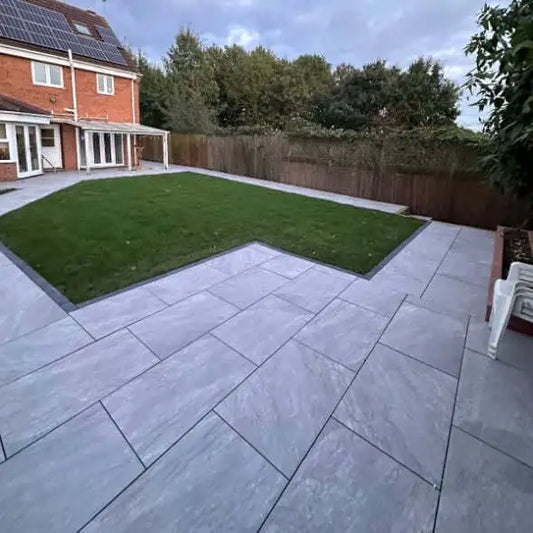
Porcelain paving slabs offer practical advantages in Glasgow's climate that deserve serious consideration. Near-zero porosity makes porcelain intrinsically frost-resistant — it absorbs virtually no moisture, so freeze-thaw damage simply cannot occur in the way it can with more porous stone. The same property makes porcelain significantly more resistant to the moss, algae, and organic growth that is a near-constant challenge in Glasgow's damp, shaded garden environment, and its dense surface is considerably easier to clean and maintain in persistently wet conditions. For homeowners who want a genuinely low-maintenance patio surface that holds up to Glasgow's climate with minimal intervention, porcelain is the strongest practical choice.
Related City Pages
Explore Paving Slabs for Patio in Gillingham.
Available Paving Categories
Helpful Paving Guides
Frequently Asked Questions
Do you deliver paving slabs for patio to Glasgow and the surrounding area?
Yes. We deliver patio paving slabs throughout Glasgow and the wider west of Scotland area, including East Kilbride, Paisley, Rutherglen, Cambuslang, Bearsden, Milngavie, Newton Mearns, and Clarkston, as well as across the broader Lanarkshire and Renfrewshire regions. Orders are dispatched on pallets via trusted UK haulage partners and carefully packaged to arrive in full condition. Delivery timescales are confirmed when you place your order.
Are paving slabs for patio frost-resistant enough for Scottish winters?
Yes. All paving slabs in our range are frost-resistant and designed for UK outdoor conditions, including the cold, prolonged winters typical of west of Scotland. Glasgow's sustained frost cycles from October through to March place greater freeze-thaw demands on paving materials than anywhere in England, and correctly specified frost-resistant slabs installed on an adequate compacted sub-base will not crack, spall, or degrade under these conditions. For maximum frost resistance with zero maintenance concern, porcelain's near-zero porosity makes it the most robust choice in Glasgow's climate.
What thickness of paving slabs for patio is recommended for Glasgow gardens?
For pedestrian patio and pathway applications, paving slabs of 22mm to 25mm provide the strength and longevity required for Glasgow's demanding conditions. The thicker end of this range is preferable in areas subject to sustained frost and repeated cold-weather cycling. For driveway or vehicle-bearing applications, a heavier slab specification is required — our size and thickness guide sets out the correct specifications for both pedestrian and vehicle-bearing surfaces.
How do I manage moss and organic growth on patio paving in Glasgow's wet climate?
Organic growth management is one of the most important ongoing considerations for patio paving in Glasgow's high-rainfall environment. For natural stone paving slabs, sealing immediately after installation is the most effective preventative measure — an impregnating sealant significantly reduces surface moisture absorption and limits the conditions in which moss and algae establish. Annual cleaning with a pressure washer and stone-safe cleaner, with sealant reapplied every two years in Glasgow's damp conditions, maintains most installations effectively. Porcelain paving is inherently more resistant to organic growth due to its near-zero porosity and requires less intensive sealing, making it a practical advantage in persistently wet gardens.
What sub-base depth is needed for patio paving slabs in Glasgow?
A compacted MOT Type 1 sub-base of at least 100mm to 150mm depth is the minimum before laying any patio paving slabs across the Glasgow area. On persistently wet, soft, or waterlogged ground — which is common across many parts of the city given the glacial clay soils and high annual rainfall — sub-bases of 150mm to 200mm and a geotextile stabilisation membrane are advisable to prevent long-term settlement. Adequate drainage cross-falls and permeable jointing are essential to manage Glasgow's sustained surface water loads. Our drainage guide covers all requirements for west of Scotland ground and climate conditions.
Is Indian sandstone or porcelain better suited to a Glasgow garden?
Both perform well in Glasgow when correctly installed, but they suit different priorities. Indian sandstone's warm natural tones and riven surface grip make it the more fitting aesthetic choice for Glasgow's sandstone architectural character, and it is genuinely durable when properly sealed and maintained. Porcelain's near-zero porosity makes it intrinsically frost-resistant and significantly more resistant to organic growth in Glasgow's persistently damp conditions — practical advantages that make it a lower-maintenance option in Scotland's challenging outdoor climate. For homeowners who want minimal ongoing intervention, porcelain is the stronger practical choice for a Glasgow garden.
```