


Kandla Grey Porcelain Paving Slabs from £22.5/m2
Kandla Grey Porcelain Paving Slabs from £22.5/m2
Couldn't load pickup availability
Kandla Grey Porcelain Paving Slabs
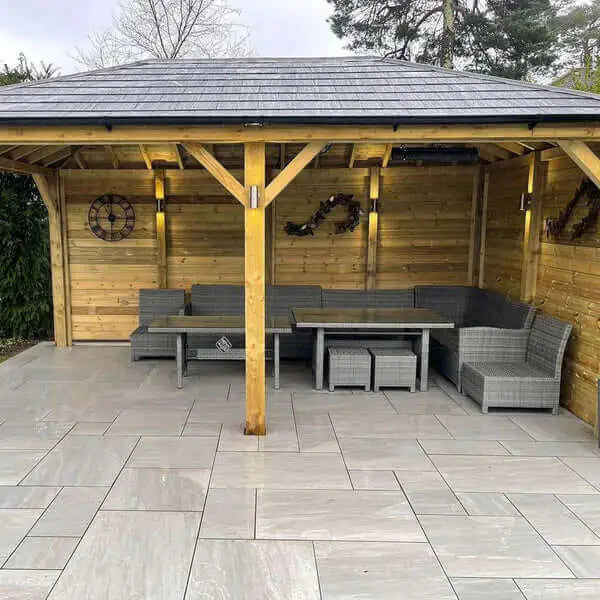
Kandla Grey Porcelain Paving Slabs offer the tonal depth and natural stone character of authentic Kandla Grey sandstone in a vitrified porcelain format that requires none of the ongoing maintenance that natural stone demands. The grey stone-effect finish replicates the subtle variation and understated cool tones of Indian Kandla stone with a consistency and precision that means every slab in a laid surface reads as part of a coherent, considered scheme. For homeowners searching for high-performance paving slabs near me to complete patios, terraces, and garden walkways across UK homes, this is a premium product that resolves the perennial tension between natural stone aesthetics and practical performance in wet, frost-prone outdoor conditions.
Supplied in a single 900x600mm format at 20mm outdoor porcelain grade thickness, these porcelain paving slabs are sized for medium to large patio areas where the larger format reduces joint frequency, creates a cleaner surface appearance, and contributes to the contemporary, seamless look that makes outdoor porcelain slabs so widely specified in modern UK garden design. Whether you are searching for versatile garden paving slabs or durable patio slabs uk homeowners trust, Kandla Grey delivers exceptional value without compromising on structural quality. Colour: Grey. Use: Ideal for patios, garden terraces, pathways, outdoor seating areas, and contemporary landscaping projects.
Kandla Grey 900x600 Product Advantages
- R11 Slip Resistance: Textured grip designed specifically for wet UK seasons.
- Vitrified Core Matrix: Near-zero porosity completely blocks frost-cracking.
- Large-Format Elegance: Clean 900x600mm profiles reduce open joint lines.
- No Chemical Sealing: Low-upkeep engineering repels leaf and organic stains.
Performance in UK Outdoor Conditions
The vitrified porcelain manufacturing process fires these slabs at extremely high temperatures, producing a dense, hard-wearing material with near-zero water absorption. In practical terms for UK outdoor use, this means moisture cannot penetrate the slab surface, the freeze-thaw damage cycle that progressively weakens more porous paving materials through winter is simply not possible, and the slab retains its structural integrity and surface finish across many years of outdoor exposure without intervention.
The UK's climate imposes specific demands on outdoor patio paving slabs that softer climates do not. Repeated wet-dry cycles through autumn, sustained damp through winter, frost between November and March, and occasional summer heat all test paving materials in different ways across a single year. Kandla Grey Porcelain handles each of these conditions through the same fundamental material property: a surface so dense that external conditions cannot penetrate or degrade it from within. No sealer is required because the protection is built into the material itself rather than applied to the surface of it.
The R11 slip resistance rating provides reliable underfoot grip in wet conditions, which matters particularly for north-facing or shaded patio areas that remain damp for extended periods after rain. The surface texture channels water away from contact points without sacrificing the refined stone-effect appearance, making these garden slabs as practical for a family patio with children as they are for a carefully designed entertaining terrace.
Stain and algae resistance are further consequences of the non-porous surface. Organic matter, food and drink spillage, leaf tannins, and garden soiling sit on the surface rather than embedding within it. Annual pressure washing consistently restores the finish without specialist cleaning products, making this a realistic low-maintenance choice for households looking for long-lasting cheap patio slabs and low-upkeep alternatives where consistent upkeep cannot always be prioritised.
Design Character and Local Scheme Integration
The Kandla Grey stone-effect finish sits in the mid-grey range with the warmth and tonal variation of natural sandstone rather than the cooler, more uniform character of concrete or engineered stone. This warmth gives Kandla Grey Porcelain broader design compatibility than colder grey alternatives, working comfortably alongside brick, natural timber, warm render, and planted borders as well as the anthracite joinery and dark furniture pairings that characterise contemporary garden design.
Because garden architectural styles vary across the country, we supply premium slabs for garden spaces with fast local delivery nationwide. From homeowners installing porcelain paving in Belfast or upgrading property spaces with paving slabs in Nottingham, to those seeking cost-effective solutions like cheap paving in Birmingham, garden slabs in Edinburgh, or premium patio slabs in Bristol, Kandla Grey Porcelain adapts effortlessly to urban and suburban garden aesthetics alike.
Creative Structural Pairings & Contrast Accents
To establish architectural definition or zoned spaces across your garden project, connect the Kandla Grey footprint with matching selections from across our store catalogues:
- Soft Tonal Interplays: For schemes that incorporate tonal contrast, Leeds Ash Porcelain Paving Slabs and Norfolk White Porcelain Paving Slabs both provide lighter counterpoints within the same porcelain format and can be used alongside Kandla Grey for feature zones, step surfaces, or secondary pathway areas.
- Deep Border Framing: For deeper contrast and bolder design statements, Manchester Midnight Porcelain Paving Slabs and Newcastle Black Porcelain Paving Slabs sit at the darker end of the porcelain palette and can be used for border definition or feature strips.
- Riven Material Variation: For those who want to incorporate genuine natural stone texture alongside porcelain, our Indian Sandstone Collection includes Kandla Grey Indian Sandstone in the same tonal family, creating visual coherence while introducing natural textural variety.
- Vertical Transitions: To extend the grey palette vertically onto boundary walls, raised beds, or garden structures, our Porcelain Claddings range includes the London Crema 600x150 Wall Cladding, which carries the natural stone aesthetic upward.
- Perimeter Details & Budget Planning: Pathway edges and border transitions can be completed with our Cobblestones Collection for considered ground-level detailing. Before starting your project budget, check our breakdown on the true cost of paving a patio in the UK, or view our guide to the best paving slabs for patios and gardens and our detailed analysis on patio slabs vs paver slabs.
Installation Specification & Best Practices
Correct installation is the single most important factor in the long-term performance of any porcelain paving. These slabs must be laid on a full continuous mortar bed over a properly compacted sub-base. Spot-bedding is not appropriate for outdoor porcelain under any circumstances, as hollow sections beneath the slab create stress concentration points that will crack under foot traffic regardless of slab quality or thickness.
Prepare a sub-base of compacted MOT Type 1 to a minimum depth of 100 to 150mm for standard residential patio use on stable ground. On clay-heavy soils, which are common across much of the UK's residential areas and can exhibit significant seasonal movement, a sub-base depth of 150 to 200mm is advisable to provide adequate bearing and reduce the risk of surface displacement over time. To ensure full bonding strength between the porcelain tile and the wet bed, ensure you apply primer correctly—see our guide on why slurry primer matters when laying outdoor porcelain slabs. Maintain a consistent joint spacing of 3 to 5mm and finish with a high-quality flexible porcelain grout once the mortar bed has cured.
A drainage fall of 1 in 80 away from the property should be incorporated into the laying level to manage surface water effectively and prevent ponding against the building. Our full Porcelain Paving Installation Guide covers every stage of the process in step-by-step detail, and our UK Paving Guidelines page provides reference to the relevant technical standards that apply to domestic paving installations. For slab sizing and thickness selection guidance, our Size and Thickness Guide covers specification decisions across the full range of applications.
Porcelain can be cut to size on site using a water-fed diamond blade porcelain cutter. A standard angle grinder is not recommended for porcelain as the harder material requires the water cooling and blade specification of a dedicated tile saw to achieve clean, chip-free cuts.
Maintenance, Upkeep & Affordable Sourcing
Kandla Grey Porcelain Paving requires no sealing at any stage. Unlike natural Kandla Grey sandstone, which needs an impregnating sealer at installation and periodic resealing every two to three years to maintain adequate moisture and stain protection, the porcelain version is inherently resistant to all the conditions that sealing addresses. Routine care is limited to annual pressure washing to remove accumulated moss, algae, and surface soiling, and inspecting the jointing annually to replace any sections that have washed out or cracked. Our guide to cleaning and maintaining paving slabs covers the full care process in practical detail.
If you are comparing different slabs for sale or looking for cheap paving slabs near me without sacrificing quality, vitrified porcelain offers an unbeatable long-term return on investment due to its structural strength and minimal maintenance demands over its lifespan.
Technical Material Matrix & Structural Specs
| Product Format | Large-Format Rectilinear Paving Flag |
| Dimensional Dimensions | 900mm x 600mm, Mix Patio Pack |
| Thickness Calibration | 20mm Calibrated Heavy-Duty Profile |
| Safety Slip Rating | Certified R11 Anti-Slip Textured Surface Grid |
| Resiliency Properties | 100% Frost-Proof, Stain-Proof, Algae-Resistant, Low Water Absorption |
Frequently Asked Questions
Is Kandla Grey Porcelain paving suitable for UK weather conditions?
Yes. Kandla Grey Porcelain is manufactured from vitrified porcelain with near-zero water absorption, making it fully frost-proof and resistant to the wet-dry cycles, sustained damp, and freeze-thaw conditions that UK outdoor surfaces experience across the seasons. The material properties that deliver this performance are inherent to the porcelain construction rather than dependent on surface treatments, so the frost and moisture resistance does not degrade over time.
Do Kandla Grey Porcelain Paving Slabs require sealing?
No. Vitrified porcelain does not require sealing at any stage. The non-porous surface inherently resists moisture, staining, algae, and frost damage without additional treatment. This is a significant practical advantage over natural Kandla Grey sandstone, which requires an impregnating sealer at installation and periodic resealing every two to three years to maintain adequate protection. With porcelain, there is no sealing cost, no reapplication schedule, and no risk of the surface being under-protected between treatments.
Are Kandla Grey Porcelain slabs slippery when wet?
No. These slabs carry an R11 slip resistance rating, which is the minimum recommended outdoor specification for domestic paving in the UK. The surface texture provides reliable traction in wet conditions across patios, terraces, and garden pathways, including on shaded or north-facing surfaces that remain damp for extended periods after rainfall. The R11 rating applies across the full lifespan of the tile and does not reduce with wear.
Can Kandla Grey Porcelain slabs be cut to size on site?
Yes. Porcelain can be cut to size using a water-fed diamond blade porcelain cutter. The harder, denser composition of vitrified porcelain requires the water cooling and blade specification of a dedicated tile saw to achieve clean, chip-free cuts. A standard angle grinder is not recommended for porcelain cutting and is likely to result in chipped or fractured edges that compromise both the appearance and the structural integrity of the cut slab.
How should Kandla Grey Porcelain Paving Slabs be installed?
These slabs must be laid on a full continuous mortar bed over a compacted MOT Type 1 sub-base. Spot-bedding must be avoided, as hollow voids beneath the slab will crack under foot traffic. Apply a porcelain slurry primer to the back of each slab before laying to ensure good adhesion with the mortar bed. Maintain a joint spacing of 3 to 5mm and finish with a flexible porcelain grout once the mortar has cured. Incorporate a drainage fall of 1 in 80 away from the building. Our full Porcelain Paving Installation Guide covers every stage of the process in detail.
How do I maintain Kandla Grey Porcelain Paving long-term?
Annual pressure washing is sufficient for routine maintenance. The non-porous surface means dirt and organic deposits do not embed in the tile texture, so pressure washing consistently restores the finish without specialist cleaning products. Inspect jointing annually and replace any sections that have washed out or cracked, as open joints allow moisture and weed growth to penetrate the bedding layer. No sealing, no specialist treatments, and no periodic reapplication of surface products are required at any point.
Share


- 5 stars: 20 (80%)
- 4 stars: 2 (8%)
- 3 stars: 3 (12%)
- 2 stars: 0 (0%)
- 1 star: 0 (0%)
Ordered 3rd time, Top quality porcelain paving slabs. Aman is very helpful.
Average experience with our kandla grey Porcelain Paving 900x600 order. The tiles look decent once laid in Norwich, but the color shade was slightly darker than online photos.
Great quality Kandla Grey Porcelain Paving Slabs 600x600. Delivery to Bolton was smooth, though the driver could only drop the pallet kerbside due to our gravel drive.
Top quality porcelain paving slabs. Ordered after reading reviews. Recommeded to everyone. Very Polite as well.
Great quality porcelain paving. The 900x600 size worked particularly well for our patio area.
Really happy with the slabs. The colour is consistent and they have given our garden a much cleaner appearance.
The paving looks even better than expected. Lovely finish and a great choice for a contemporary patio.
Ordered porcelain paving for our garden renovation and we're very impressed with the final result. Looks fantastic.
Excellent porcelain paving for the price. The finish is modern and the slabs feel very substantial.
Very happy with the quality of these porcelain slabs. They have completely changed the look of our patio.
Really pleased with the porcelain paving. The colour is exactly what we were looking for and the slabs look excellent once laid.
Good quality porcelain paving and very happy with the purchase. The slabs arrived securely packaged and look fantastic.
Really happy with our new patio slabs. The colour works beautifully with the rest of the garden.
Excellent porcelain slabs. They look really smart and the finish is exactly what we wanted for our garden patio.
Nice quality porcelain paving and very pleased with the finished appearance. The pallet packaging had some damage, but thankfully the slabs were fine.
Very happy with the paving slabs. The colour is consistent and the finished patio looks brilliant.
Excellent quality and a beautiful finish. The porcelain paving has given our patio a much more modern look.
Tiles are absorbing water, not a good product
Great quality kandla garden slabs. The colour and texture are both very attractive and the finished area looks fantastic.
Really happy with the Kandla Grey porcelain paving slabs. The finish is excellent and they have made the patio look much more expensive
Looks Great. Happy with the product and its price.
Product is great. Just received a delivery of 3 Pallets. Looks Good. Thanks
Very pleased with the Black Basalt porcelain paving. Easy to maintain, excellent finish and perfect for creating a modern outdoor patio.
These porcelain paving slabs look even better once installed. The deep charcoal colour gives our garden a smart and contemporary finish.
The product is fine - eventually. Big problems with delivery & communication