Southampton occupies a unique position on England's south coast — a bustling port city nestled between the Test and Itchen estuaries, with the New Forest to its west and the Hampshire countryside stretching north towards Winchester and Basingstoke. This coastal and estuarial setting shapes everything from the local microclimate to the soil conditions underfoot, and it plays a direct role in the paving choices that perform best across the city's varied neighbourhoods.
At Paving and Slabs Ltd, we supply premium patio paving slabs to homeowners, landlords, and landscaping professionals across Southampton — from the dense Victorian streets of Shirley and Freemantle to the newer residential estates of Hedge End, Chandler's Ford, and Totton. Our product range is chosen with southern coastal conditions in mind, and we back every order with detailed guidance to help customers get lasting results from their investment.
Understanding Southampton's Climate Before You Lay
Southampton sits in one of the milder corners of the UK. Winters are relatively frost-light compared to northern England, though ground frosts do occur between December and February and should not be dismissed when choosing paving materials. The city receives around 750mm of rainfall annually — slightly above the UK average — and its coastal exposure means Atlantic weather systems arrive with some regularity, bringing wind-driven rain and persistent damp across autumn and winter months.
The proximity to the Solent also introduces mild coastal salt air into the equation, particularly in lower-lying areas close to the waterfront, St Denys, and Woolston. Salt-laden air accelerates surface degradation in more porous materials and can attack grouting and jointing compounds over time. This makes surface sealing and material selection more important in Southampton than in many inland cities of comparable size.
Summer, by contrast, brings some of the highest UV exposure in the UK outside of the far south-west. UV intensity can bleach and fade certain natural stone finishes over time, which is worth factoring in when choosing between lighter and darker colourways for a south-facing garden.
Soil Conditions and Drainage Across Southampton
Southampton's ground conditions vary meaningfully depending on which part of the city you're working in. Much of the central and western areas sit on a mix of river gravel terraces and Southampton Water alluvium — ground that can be reasonably free-draining in dry conditions but prone to waterlogging after prolonged rain. The chalk belt that defines much of Hampshire begins to assert itself further north of the city, particularly towards Eastleigh and Chandler's Ford, where sharper drainage is more common.
In established residential areas like Bassett, Portswood, and Swaythling, made ground and urban fill are not uncommon beneath garden surfaces — a legacy of the city's development and post-war reconstruction. Where made ground is present, sub-base preparation becomes critical. A compacted layer of MOT Type 1 hardcore, typically 100mm at minimum and up to 150mm in softer ground conditions, should be considered non-negotiable before any paving is laid.
For guidance on getting drainage right from the outset, our Drainage Guide is an essential read, particularly if your garden slopes towards the house or sits in a lower-lying street. UK permeable surface rules also apply to driveways in many cases — our UK Guidelines page covers the planning considerations in full.
Property Types Across Southampton and Matching Paving Styles
Southampton's housing stock reflects its layered history as a major port city. The Victorian and Edwardian terraces of Shirley, Freemantle, and St Mary's remain some of the most densely occupied residential streets in the city, characterised by long rear gardens and narrow frontages. For these properties, traditional natural stone finishes — riven Indian sandstone in warm buff or silver tones, or classic grey concrete-effect porcelain — tend to suit the period character far better than oversized contemporary slabs.
Moving into the leafier suburbs of Bassett, Chilworth, and Chandler's Ford, larger detached and semi-detached homes with wider garden plots lend themselves to more ambitious patio designs. Large-format porcelain slabs in 600x900mm or 600x1200mm sizes are particularly popular in these areas, creating expansive outdoor entertaining spaces that mirror the architectural scale of the properties themselves.
Southampton also has a significant stock of 1950s and 1960s bungalows, especially across Sholing, Bitterne Park, and Hedge End. These properties often have level rear gardens with good access, making them ideal candidates for straightforward patio upgrades. Landlords operating across the private rental market — which is substantial in Portswood, Bevois Valley, and around the university areas — increasingly opt for low-maintenance porcelain for its durability and ease of upkeep between tenancies.
For ideas across different property and garden types, our guide to flagstone patio designs that transform outdoor spaces is a useful starting point.
Choosing Between Porcelain and Indian Sandstone in Southampton
Both materials have strong advocates in Southampton, and both can perform excellently here when chosen and installed correctly. The decision usually comes down to maintenance preference, budget, and the aesthetic character of the property.
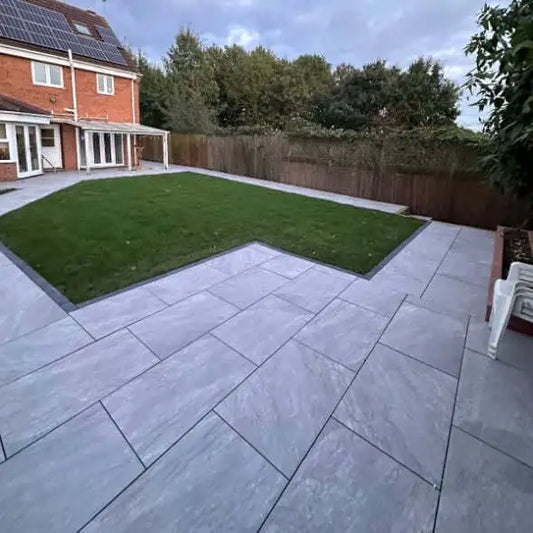
Porcelain paving is the practical frontrunner for Southampton's coastal-influenced conditions. Its near-zero porosity means salt air, rain, and surface moisture cannot penetrate the slab, keeping it resistant to frost, algae, and staining over time. In a city where autumn and winter damp can persist for weeks at a stretch, the reduced cleaning burden alone makes porcelain attractive. It also holds its colour well under UV exposure during the long southern summers.
Indian sandstone brings a warmth and natural variation that many Southampton homeowners prefer, particularly those with older properties where a more organic finish feels right. The key requirement in a coastal, higher-rainfall location like Southampton is thorough sealing on installation and consistent resealing every two to three years. Our detailed guide on cleaning and sealing Indian sandstone covers exactly how to do this.
If budget is a primary consideration and you're weighing up paving against alternatives like gravel or decking, our breakdown of real-world costs across patio surface types sets out the long-term value comparison clearly. And if you're deciding between traditional slabs and individual pavers, our guide on patio slabs vs paver slabs covers the practical trade-offs in full.
Available Paving Ranges for Southampton
We stock a comprehensive range of paving products suited to Southampton's climate, property types, and design preferences:
-
Indian Sandstone — natural, characterful paving in a range of tones and surface textures, best sealed for coastal and high-rainfall use
-
Paving Slabs — a versatile range spanning traditional concrete flags through to contemporary finishes, suited to most budgets
-
Porcelain Paving — the low-maintenance premium choice, offering exceptional durability in wetter and salt-affected environments
For further inspiration on styles and finishes currently trending for UK gardens, our roundup of the best paving slabs for patios and gardens in 2025 is worth a look before you finalise your choice.
Slab Thickness and Installation Guidance
For residential garden patios and paths in Southampton, 20–22mm slabs are typically sufficient when laid correctly on a full mortar bed with adequate sub-base preparation. Where slabs will be subject to regular vehicle access — driveways, side returns used for parking, or commercial areas — a minimum of 30mm thickness is advisable to prevent cracking under load.
Southampton's occasional ground movement, particularly in areas with alluvial or made-ground soils, underlines the importance of a solid, well-compacted sub-base. Cutting costs at sub-base stage is one of the most common reasons patio projects fail prematurely. Our full Installation Guide walks through sub-base depth, mortar mix ratios, and jointing options step by step.
Once your patio is complete, regular maintenance will extend its life considerably. Our guide to cleaning and maintaining paving slabs covers seasonal upkeep, pressure washing guidance, and when to re-joint.
Delivery to Southampton and Surrounding Areas
We deliver paving orders to Southampton and across Hampshire, including Eastleigh, Fareham, Hedge End, Romsey, Totton, and into the New Forest. Deliveries are made on pallets via specialist freight courier. We ask customers to ensure clear vehicle access to the delivery point — particularly important on the narrower residential streets common in Shirley, Woolston, and inner Southampton — and that someone is available to receive the consignment.
Lead times depend on product range and time of year. Porcelain ranges are generally held in stock for prompt despatch, while certain natural stone ranges may carry a short lead time. If you're working to a specific installation date, contact us before ordering and we'll confirm availability and delivery windows for your postcode.
Related City Pages
Explore paving slabs for patios in Solihull.
Frequently Asked Questions
Do you deliver paving slabs to Southampton?
Yes, we deliver to Southampton and throughout Hampshire, including Eastleigh, Fareham, Hedge End, Romsey, Totton, and the New Forest area. Orders are sent on pallets via specialist freight courier. Please ensure clear vehicle access and availability to receive the delivery. Get in touch before ordering if you have access restrictions or a firm installation deadline.
Which paving material performs best in Southampton's coastal climate?
Porcelain paving is the strongest performer in Southampton's conditions. Its near-zero porosity makes it highly resistant to salt air, persistent damp, and the mild frost cycles the city experiences in winter. Indian sandstone is also a popular and attractive option, but requires thorough sealing on installation and periodic resealing to hold up well against moisture and coastal air exposure.
Does Southampton's soil affect how paving should be installed?
Yes. Much of central and western Southampton sits on river gravel terraces and alluvial ground that can waterlog after heavy rain. In areas with made ground or urban fill beneath the surface — common across established residential neighbourhoods — a compacted MOT Type 1 sub-base of at least 100–150mm is essential before laying any paving. Skipping or reducing the sub-base is one of the most common causes of premature paving failure.
What slab thickness do I need for a garden patio in Southampton?
For standard residential patios and garden paths, 20–22mm slabs are generally adequate when laid on a full mortar bed with proper sub-base preparation. For driveways or areas subject to vehicle traffic, a minimum of 30mm is recommended. Always pair your slab choice with appropriate sub-base depth for your specific ground conditions.
Is Indian sandstone a good choice for a Southampton garden?
Indian sandstone works very well in Southampton gardens when properly installed and maintained. Given the city's rainfall levels and coastal salt air, sealing is strongly advised — apply a quality impregnating sealer at installation and reseal every two to three years. When maintained correctly, sandstone develops a beautiful natural character and can last for many decades.
Do I need planning permission for a new patio or driveway in Southampton?
Patios in rear gardens generally do not require planning permission. However, front garden driveways and hard surfaces are subject to UK permeable surfacing rules — if the area exceeds 5 square metres, a permeable surface or provision for run-off drainage is required to avoid a planning application. Our UK Guidelines page covers the key rules in full and is worth reviewing before beginning any front garden project.
How do I keep paving slabs looking good in a wetter coastal environment?
Annual pressure washing removes algae, moss, and general dirt build-up. For natural stone, resealing every two to three years prevents moisture ingress and surface staining. Inspect jointing annually and replace any areas where the compound has cracked or eroded, as open joints allow water penetration that accelerates frost and root damage. Our full maintenance guide covers all surface types and seasonal care routines.