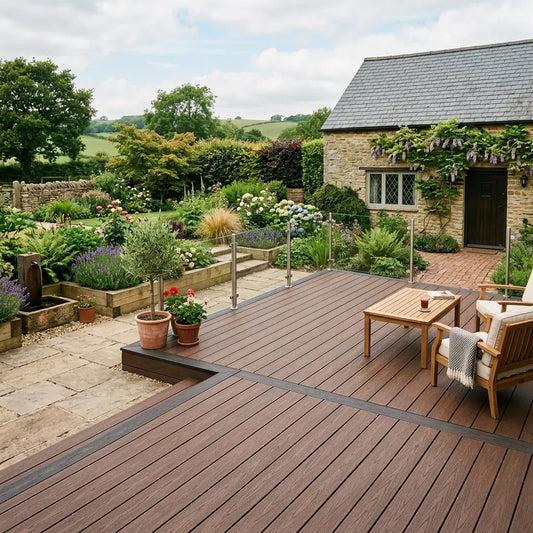
Composite Decking Installation Guide

Installation Guide

Composite Decking
Step-by-Step Installation

A complete UK guide to installing WPC composite decking boards — from subframe construction and hidden T-clip fixing through to finishing, edging, and drainage.

🪵 WPC Composite Boards 🏠 UK Residential & Commercial 🌧️ Rot, Slip & UV Resistant ⏱️ Full deck in 1–2 days
⚠️

Before You Begin — Important

  • Allow composite boards to acclimatise on site for 24–48 hours before installation, especially in summer months when thermal expansion is greatest.
  • Inspect all boards before fitting. Do not install boards with visible defects. Once boards are cut or fixed, returns cannot be accepted.
  • Ensure the subframe and any existing surface beneath the deck has adequate drainage — standing water under a deck accelerates subframe degradation and can cause ground heave.
  • For decks over 600 mm above ground level, UK Building Regulations (Part K) may require handrails or balustrades. Check with your Local Authority before building.

🔧 Tools & Materials Required

  • Composite decking boards
  • Timber or steel subframe joists
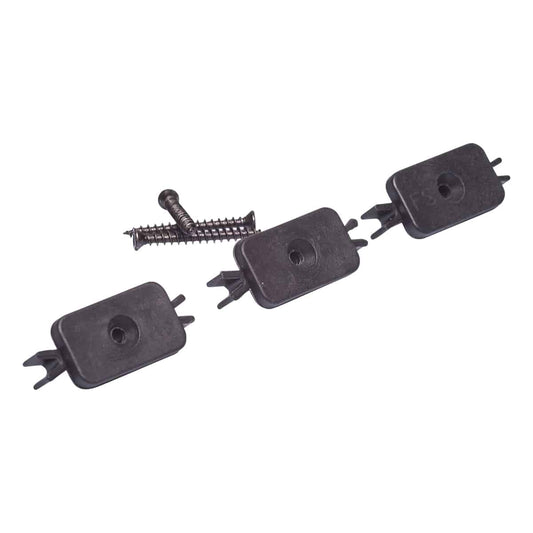
  • Hidden T-clip fixings & screws
  • Stainless steel or galvanised screws
  • Circular saw or mitre saw
  • Tape measure & chalk line
  • Spirit level (1.2 m+)
  • Drill & impact driver
  • Rubber mallet
  • Joist hangers & post supports
  • Weed suppression membrane
  • Safety goggles, gloves & dust mask

📐 Subframe Specification — Key Dimensions

400 mm

Max. Joist Spacing — Standard

Maximum 400 mm centre-to-centre for standard residential decking boards laid at 90° to joists.

300 mm

Joist Spacing — Diagonal / 45° Lay

Reduce joist spacing to 300 mm maximum when laying boards diagonally at 45°, as the span is greater.

50 mm

Minimum Ground Clearance

Subframe must sit at least 50 mm above finished ground level to allow airflow and drainage beneath the deck.

5–8 mm

Board-End Expansion Gap

Leave 5–8 mm at board ends and a minimum of 6 mm between board sides for thermal expansion throughout the year.

Step-by-Step Installation

Follow all 10 steps in order for a structurally sound, professional composite deck installation.

STEP 1 Plan & Calculate

Plan your deck layout

Measure the deck area precisely. Decide on board direction (90° or 45°). Use our coverage calculator to determine the exact number of boards needed. Plan your subframe joist layout on paper first.

📐 Decide board direction before ordering — 45° needs ~10% more boards
STEP 2 Prepare the Ground

Clear, level & prepare the ground

Remove all vegetation, debris, and topsoil within the deck area. Lay a weed suppression membrane over the cleared ground to prevent growth beneath the deck. For soft ground, add compacted hardcore or a gravel base.

🌿 Weed membrane prevents costly future problems
STEP 3 Install Post Supports

Fix subframe post supports

Set adjustable post supports or concrete pad footings at joist intersections. Use a string line and spirit level to ensure all supports are at the same height. This is critical — an uneven subframe leads to an uneven deck.

📏 All supports must be exactly level
STEP 4 Build the Subframe

Construct the timber or steel subframe

Build a rectangular perimeter frame first, then add internal joists at 400 mm centres (300 mm for diagonal lay). Use pressure-treated C24 timber (minimum 47×100 mm) or galvanised steel joist for longer life. Fix with joist hangers.

🪵 Use C24 pressure-treated timber — not CLS
STEP 5 Check Level & Square

Check subframe is level and square

Place a long spirit level across joists in multiple directions. Check the diagonals are equal to confirm the frame is square. Build in a 1:80 fall away from the house (approx. 12 mm per metre) for water drainage.

💧 1:80 fall away from house for drainage
STEP 6 Lay First Board

Fix the first board — set the line

Start from the house wall or most visible edge. Leave a 10 mm expansion gap from the wall. Fix the first board with a face-fix screw at each joist — this starter board sets the alignment for all subsequent boards. Check it's straight.

10 mm gap from any fixed structure or wall
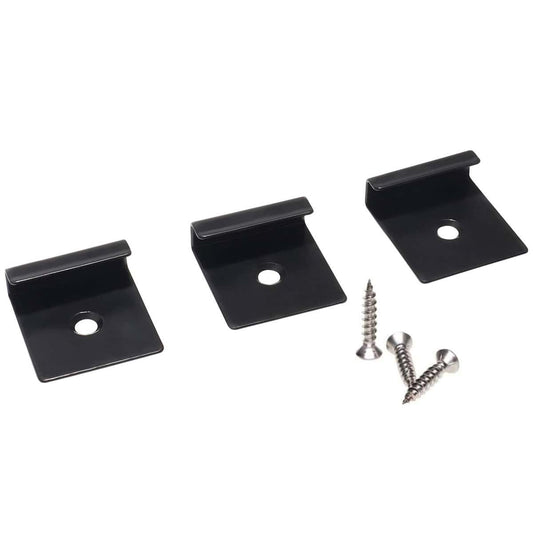
STEP 7 T-Clip Hidden Fixing

Install T-clip hidden fixings

Slot the T-clip into the groove on the side of the laid board and screw down into the joist. The next board slides over the clip, hiding all fixings for a clean, screw-free surface. Use one clip per joist crossing per board.

✅ T-clips give a professional screw-free finish
STEP 8 Continue Laying

Continue laying boards across the deck

Work across the deck, fitting boards and T-clips row by row. Use a rubber mallet to tap boards firmly home if needed. Do not force boards — the side gap of 5–8 mm must be maintained for thermal expansion throughout the year.

🔨 Tap gently with rubber mallet only
STEP 9 Cut & Fit Last Board

Cut and fix the final board

Measure the remaining gap carefully. Rip-cut the final board to width if necessary, leaving the 10 mm expansion gap from any fixed structure. Face-fix this last board as with the first, as T-clips cannot be used on the final row.

📐 Measure twice before cutting the final board
STEP 10 Edge Trim & Finish

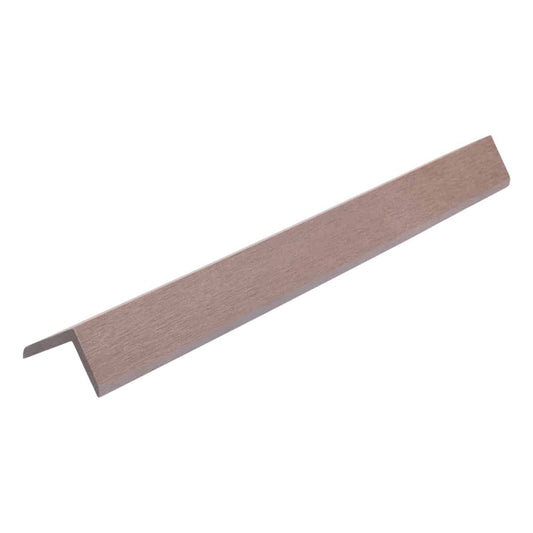
Fit fascia boards & edge trim

Fix composite fascia boards around the perimeter of the deck to conceal the subframe, board ends, and expansion gaps. Mitre corners at 45° for a clean finish. Step back and inspect — check all boards are flush and secure before use.

✅ Fascia boards complete the professional finish
Board Fixing Methods

Two fixing methods are available — choose based on your preference for finish and speed.

A
Hidden T-Clip Fixing
Recommended method
RECOMMENDED

T-clips slot into the board's groove channel and screw down to the joist. The next board covers the clip completely. Result: a completely screw-free, smooth surface with no trip hazards or water-collecting screw holes.

✓ Best finish · No visible fixings
B
Face Screw Fixing
Alternative method

Screws are driven directly through the face of the board into the joist below. Use stainless steel or A4-grade screws only — standard steel will rust and stain the board face. Pre-drill to prevent splitting. Use for first and last boards regardless of method.

⚡ Faster install · Visible fixings
Key Specifications

Reference data for planning and installation.

Board size (standard)3600 × 150 × 25 mm
Board coverage per unit0.54 m² (3.6 m × 0.15 m)
Max. joist spacing (90° lay)400 mm centres
Max. joist spacing (45° diagonal)300 mm centres
Board side expansion gap5–8 mm
Board end expansion gap5–8 mm
Gap from walls / structures10 mm minimum
Minimum ground clearance50 mm
Recommended drainage fall1:80 (12 mm per metre) away from house
Subframe timber (minimum)47×100 mm C24 pressure-treated
Screw type (face fix)A4 stainless steel only
Acclimatisation period24–48 hours minimum

🇬🇧 UK Building Regulations — What You Need to Know

  • Ground-level decks (under 300 mm above ground) do not typically require Building Regulations approval.
  • Decks over 600 mm above ground level require Part K compliant guarding (balustrade) at least 1,100 mm high for domestic use.
  • Decks attached to or near a Listed Building or within a Conservation Area may require Listed Building Consent or Planning Permission regardless of size.
  • If in doubt, contact your Local Authority Building Control (LABC) before commencing construction.
💡

Pro Tips for a Flawless Composite Deck

  • Never skip the expansion gaps — WPC composite expands and contracts significantly with UK seasonal temperature swings. Boards installed tight will buckle in summer.
  • Mix boards from at least 3 different packs as you lay, to evenly blend any natural batch colour variation across the finished deck.
  • Always cut boards with the good face down when using a circular saw to minimise surface chipping.
  • Seal all cut board ends with an end grain sealant where boards are cut to length — this prevents moisture ingress at exposed end grain.
  • For boards over 3.6 m, always join on a joist and leave the 5–8 mm end gap at the join point.
  • Clean the finished deck with a soft brush and soapy water — never use a pressure washer at high pressure as it can raise the board surface texture.

Questions? We're Here to Help.

Contact our team for technical advice, quantities, or fixing queries.